


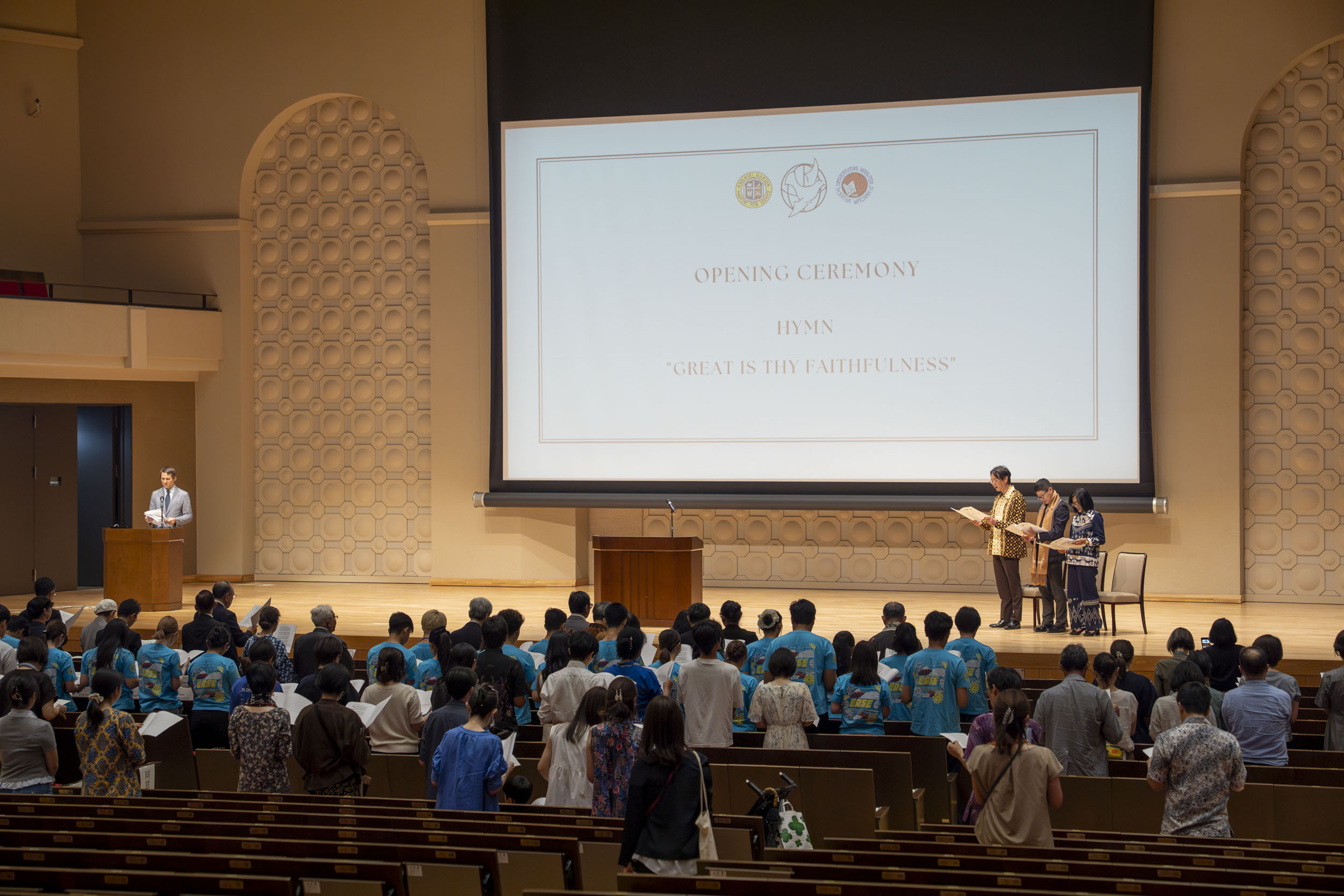
On August 8, 2026, a ceremony was held at the Nishinomiya Uegahara Campus Central Auditorium to commemorate the upcoming 50th anniversary of the East Asia Student Encounter (EASE), the Indonesia exchange seminar that is KGU’s longest-running international program, and approximately 130 people attended. 1244 students from KGU and its Indonesian partner institution, Satya Wacana Christian University, (UKSW) have participated in the EASE initiative, which began in 1977 and has a rich history. The theme of EASE this year, which began on August 1, was “Manifest the Dream: Our Journey Toward Peace in a Divided World.” During the 13-day program, 29 students participated in a diverse array of cultural exchange activities, in addition to listening to stories from atomic bomb survivors and visiting Hiroshima.
At the commemorative ceremony, both university presidents gave opening remarks. Speaking on the results of program initiatives over the past 50 years and his hopes for the future, President Yasutoshi Mori said, “For 50 years, Japanese and Indonesian students have gone beyond their cultural and religious differences to cultivate mutual understanding and friendship. In an era of increasing division and uncertainty, respecting each other’s differences and engaging in dialogue and cooperation leads to peace, and EASE has put this philosophy into practice. I would like to continue expanding our cooperation going forward, and develop next-generation leaders who will contribute to a more peaceful and considerate society.” UKSW President Intiyas Utami then expressed her determination, saying “I would like to celebrate our friendly relationship reaching this major 50-year milestone, continue EASE, and develop the ties between our universities even further.”
To go along with the theme of the program, Koko Kondo, an atomic bomb survivor and peace activist, gave the keynote speech, “Peace Inside Your Heart.” Kondo, a KGU alumna, spoke to a rapt audience about the time that her father Rev. Kiyoshi Tanimoto was invited onto an American TV program to meet with the co-pilot of the Enola Gay, the B-29 that dropped the atomic bomb on Hiroshima.
There was also a panel discussion entitled “Citizens for Peace: Indonesian–Japanese Civic Leadership in Turbulent Times,” moderated by Prof. Tomoru Hiramatsu of the School of Policy Studies, with panelists from both universities who have been involved with EASE over the years. Former UKSW president Willi Toisuta, the founder of EASE, reflecting on the history of how the program’s philosophy has evolved from international understanding to world peace, said that “From now on, we must not merely commemorate peace; rather, we are called upon to develop this program into an educational forum that fosters responsible citizens, whilst also focusing on justice and the environment.” Chancellor Motoo Nakamichi then gave the closing address to end the ceremony.
A fourth-year student from the UKSW School of Theology who took part said, “Amidst ongoing wars and humanitarian crises around the world, I felt it was important to re-examine the ideal of peace that EASE has championed, and to realize that it is not enough merely to hope for peace. We must take action ourselves. We need to go beyond simply building relationships and fostering cooperation; we must consider what we can do for peace through EASE and what specific actions we can take together.” A second-year student from the School of Policy Studies spoke about what they had learnt from the program, saying, “I believe this program is not a goal of university life, but rather a catalyst for all sorts of things. I took part in EASE to be a catalyst for someone else. I don’t know yet whether I can be a catalyst for anyone, but I myself have certainly found a catalyst.”